




Results of D&D Practitioners Survey are Available
 If you haven’t yet, be sure to check out the site sociologists (and NCDD members) Caroline Lee and Francesca Polletta created at http://sites.lafayette.edu/ddps/ to display the results of the 2009 Dialogue and Deliberation Practitioners Survey. You can also download the full survey results here.
The survey was conducted online last Fall for the purpose of academic research on the deliberation field by the researchers. Francesca and Caroline felt that the field of public dialogue and deliberation has been growing so dramatically that no one fully knows what the field looks like. They sought to answer questions like:
- Who is doing public dialogue and deliberation work?
- What forms is their work taking?
- What common challenges do they face?
- How they would like to see the field develop?
The data they collected is extraordinarily valuable for our field, and you are encouraged to site it and utilize it widely. On the site, you can download or browse the survey results, ask a question of the researchers, or join a discussion about the findings.
Here are some of the results I found most interesting/useful from NCDD’s perspective:
Participants were asked to rate the importance of the 5 challenges facing the D&D community that were identified by NCDD conference participants:
- 34% identified the Systems Challenge as our most important challenge (making D&D integral to our public and private systems).
- Three of the challenges were seen as most important by 20% each:Â the Framing Challenge (framing D&D work in a more accessible way), the Action & Change Challenge (strengthening the link between D&D, action and policy change), and the Evaluation Challenge (demonstrating to powerholders that D&D works).
- Notably, only 6% indicated that the Inclusion Challenge (addressing oppression and bias) as the most important challenge facing our field.
When asked who should take the lead in advancing dialogue and deliberation in the U.S., “professional associations” like NCDD and IAP2 was selected most often (62%), followed by an “alliance of experienced local organizations” (51%), the White House Office of Public Engagement (48%), “national D&D facilitation organizations” like AmericaSpeaks and National Issues Forums (47%), foundations that support D&D (47%).
57% of respondents prefer the term “community of practice” to describe the people and organizations currently leading D&D efforts, compared to 16% who prefer “movement” and 11% who prefer “profession.”
Of the 4 engagement streams (exploration, conflict transformation, decision making and collaborative action), conflict transformation was the only one selected by less than half (38%) of respondents indicating the type of D&D work they practice. (more…)
 Peter Levine had an important article published on the Huffington Post yesterday titled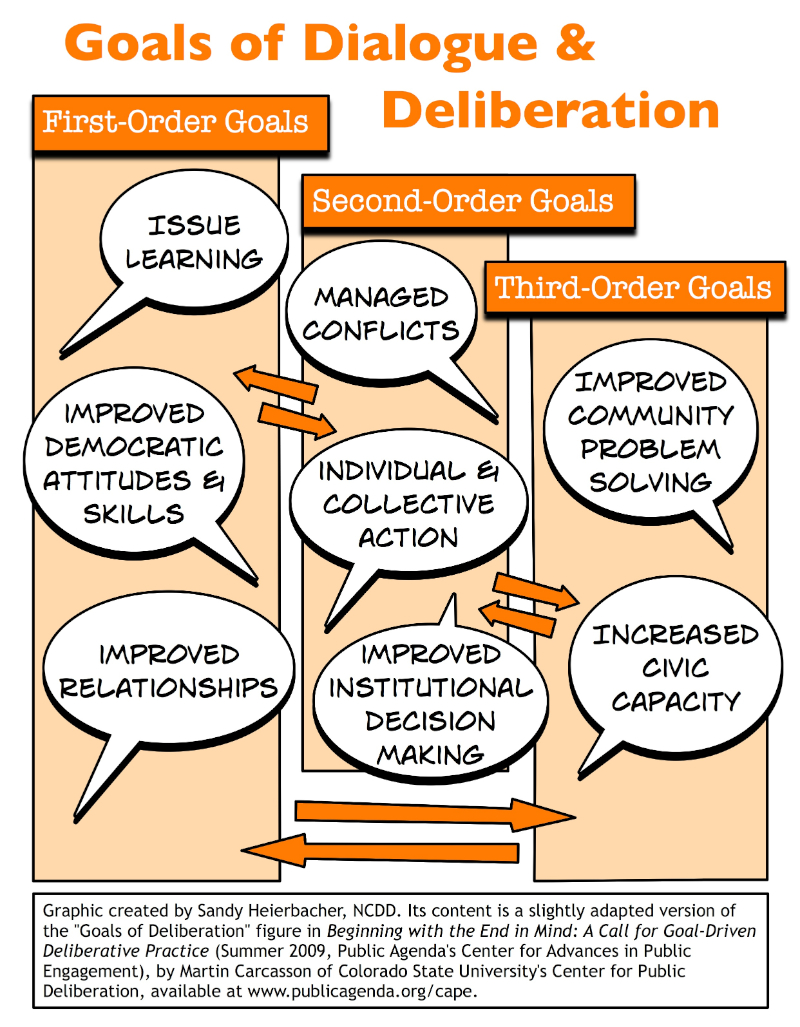
 This is my eighth blog post featuring content of an article published in the latest edition of the International Journal of Public Participation (IJP2), titled Taking our Work to the Next Level: Addressing Challenges Facing the Dialogue and Deliberation Community. The article outlines our learnings in two of the five challenges we focused on at the 2008 NCDD conference in Austin: the “Systems Challenge†(How can we make D&D values and practices integral to government, schools, and other systems?) and the The “Framing Challenge†(How can we talk about and present D&D work in more accessible ways?). You can download the full article from the IJP2 site.
 During our “Reflective Panel†plenary session, a conversation among four leaders in the dialogue and deliberation community, panelist Carolyn Lukensmeyer (President of
 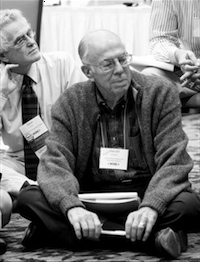 Several workshops focused on creating or capitalizing on what Archon Fung and
  Todd Davies
 Five themes emerged in discussions about this challenge area…
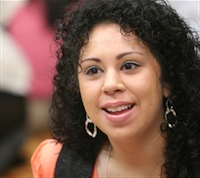 At the
  Many times, the potential for concrete outcomes or results needs to be underscored in big, bold letters. This often means identifying language that explicitly connects the public engagement process or program to solving a particular problem people are facing. In the online dialogue we held before the conference to explore the five challenge areas,
  While there may not be a single framing of public engagement that works for all audiences, practitioners are increasingly finding success in focusing on the purpose or potential outcomes (in general) of engagement. Specifically, framing in terms of problem solving and identifying and working towards a desirable future seems to resonate with broad audiences. In the online dialogue,
  The public engagement field and related fields struggle with the fact that many more progressives than conservatives are attracted to this work. The vast majority of practitioners are politically progressive, and it is typically more challenging to recruit people with more traditional or conservative views to participate in dialogue and deliberation programs.
 The concept of blind spots in our language – terms and phrases that dissuade or confuse without our realizing it – was discussed in the online dialogue.
  Now for blog post #1…